


Do you need a document translation…you come across the term „standard page“ everywhere, but you don’t actually know what it is and how it is calculated? In translation practice, this is common terminology, as well as, for example, in the field of journalism, where journalists create articles with a certain number of standard pages, or students submit professional and final theses that must meet the minimum number of standard pages. So how big is a standard page and how can you calculate it?
A standard page (abbreviated NS) is a standardized page of text with a certain number of characters (excluding spaces/including spaces) and lines. In the Czech environment, a standard page can be defined in two ways:
The number of standard pages may not correspond (and usually does not correspond) to the number of physical pages of the printed text. Usually, the number of standard pages is significantly larger than the number of pages actually printed, which depends on many other parameters: text format, font size (grade), line spacing, paragraph division, etc.
When billing for translation work, there are sometimes disputes over whether the work should be billed based on the standard pages or word count of the original text, or the standard pages or word count of the final translated text.
Due to the linguistic differences between individual languages and cultures, which include, for example, different syntax, definite and indefinite articles, or the length or formation of words, the price is usually calculated based on the number of standard pages of the translated text.

When calculating based on the output text, it is necessary to take into account that the length of texts is different when converted into individual languages. For example, German, Spanish, French are approximately 20–30% longer than Czech. Other languages may be slightly shorter. This is due to their different structure, as we mentioned above.
In the case of translation into/from character script (Japanese, Korean, Chinese, etc.) but also Hebrew or Arabic, it is recommended to use the language that is written in Latin script to calculate the translation price.

The scope of the Czech standard page does not automatically apply in other countries. Although it is sometimes stated that the scope of 1,800 characters is international, this is only partially true. Only in countries neighboring the Czech Republic does the established standard page have different parameters, e.g.:
Some publications state that agencies that calculate a standard page, which does not have the legally derived 1,800 characters, but an undersized 1,650 or even 1,500 characters, are only trying to make money on the client. However, this statement may not be entirely based on the truth. The basic difference and decisive parameter in this case are the spaces. There is a significant difference whether you divide the amount of text by 1,500 characters without spaces or including spaces. With correct document formatting, the calculation for both +/- variants should match. A comparison of the individual calculations is provided below.
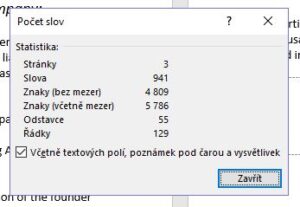
From the above calculation it is clear that the resulting calculation of the number of standard pages is the same whether we calculate the standard page as 1800 characters including spaces or 1500 characters without spaces.
According to Act No. 354/2019 Coll. Act on Court Interpreters and Court Translators, each started page is charged as a whole, just as each separate document is charged separately.
Our company I.L.T.S. also offers court and ordinary translations, which are prepared in standard and express terms, in more than 40 languages, both from and into a foreign language. In addition, we will process a price calculation for each request/order in advance, completely free of charge.