our services

Superlegalization

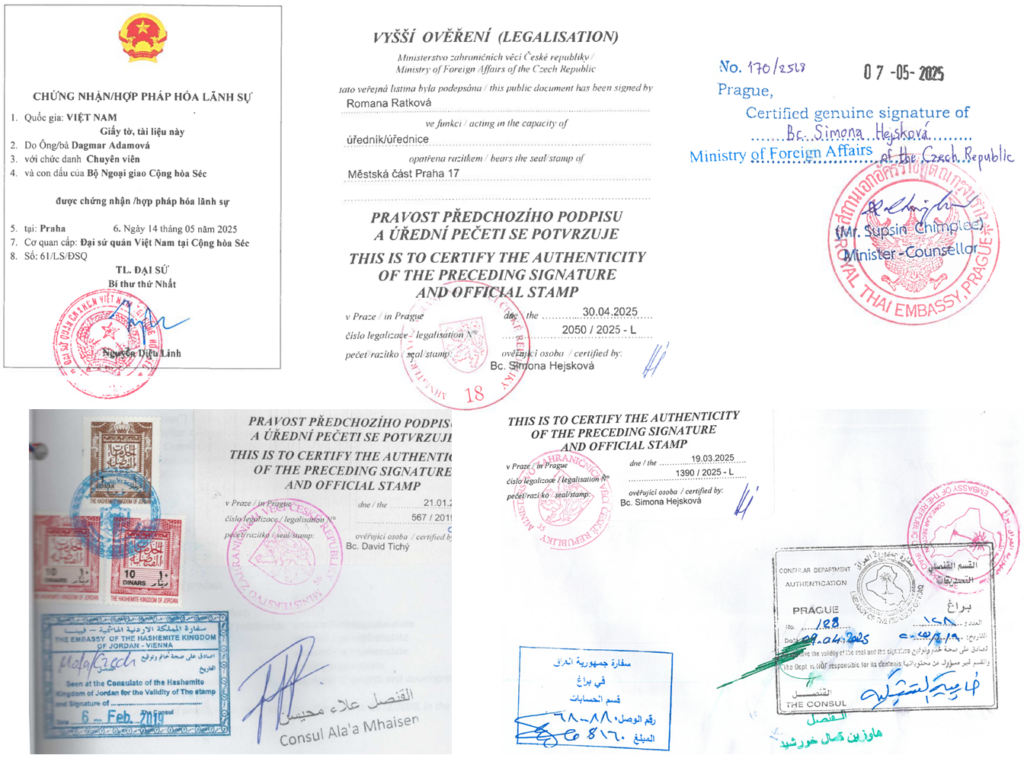
Superlegalization, also referred to as a higher level of authentication, is an administrative act by which a public document – or a document that has already been officially certified – is authenticated for the purpose of its use abroad.

If a public document issued or certified by a Czech authority within the scope of its competence is to be recognized abroad, it must not only be legalized or superlegalized, but also properly translated into the official language of the destination country. In such cases, the certified translation itself must also be legalized.

The validity of a superlegalized document is not limited; however, it always depends on the type of document and the specific requirements of the authorities in the foreign country where the document is to be used.

What Is the Superlegalization Procedure?

The superlegalization of Czech documents is carried out by the central authority of state administration that is superior to the authority which issued the document. This is followed by further verification of the signature and official stamp of that superior authority by the Ministry of Foreign Affairs of the Czech Republic, and finally by authentication by the diplomatic or consular mission of the country in which the document is to be used. This is a relatively complex and time-consuming administrative process. We will be happy to assist you with it and arrange the superlegalization on your behalf.

Superlegalization is not required in cases where an international treaty binding on the Czech Republic applies, such as the Convention Abolishing the Requirement of Legalization for Foreign Public Documents of 5 October 1961, which abolished the requirement of superlegalization between the contracting states and replaced it with a special certificate known as an apostille. Superlegalization is also not required if the Czech Republic has concluded a bilateral international agreement with the relevant country providing for an exemption from document authentication.

  • Legalization verifies the authenticity of the signature and the official stamp affixed to the document.
  • Legalization is carried out on the basis of a register of signatures of public administration officials. It therefore always depends on a correct and valid specimen signature of the signing or certifying person. If the signature is not valid, the document cannot be legalized.
  • Legalization does not confirm the accuracy or truthfulness of the information contained in the document, nor its compliance with legal regulations. The authority is not responsible for the content of the document.
  • Legalization is indicated on the document by affixing a legalization certificate and the official stamp of the competent authority.
  • Finally, the document is authenticated by the diplomatic mission of the foreign state (embassy, consular section, or honorary consulate) competent for the Czech Republic.
certifikat2

Vital Records

(birth certificates, marriage certificates, death certificates)

majitelé

Extracts from Registers of Individuals

(criminal record, population register, etc.)

svatba

Marriage Documentation

(certificate of legal capacity to marry, baptism certificates, etc.)

graduation

Educational Documents

(enrolment confirmations, diplomas, supplements, certificates, transcripts)

kancelář

Corporate Documents

(contracts, articles of association, notarial deeds, incorporation documents)

obchod

Company Register Extracts

(commercial register, trade register, insolvency register,etc.)

banka3

Financial Administration Documents

(tax residency confirmation, debt-free statement, VAT registration, etc.)

certifikat3

Commercial Certificates

(GMP SÚKL, ML, ISO, Free Sale, etc.)

certifikat_diplom

… and other public documents issued or certified by Czech authorities

Do you have any further questions about superlegalization?

For further questions about legalization / consular legalization, please feel free to contact us by phone, email, using the inquiry form or visit us in person at Washingtonova 5, Prague 1. Frequently asked questions and answers are also available in the FAQ section.